

Buy Now, Pay Later Debt Could Hurt Your Mortgage Approval

Buying a Home? Why “Buy Now, Pay Later” Purchases Can Hurt Your Mortgage Approval
“Four easy payments.” “Pay over time.” “Only $75 a month.”
Buy Now, Pay Later plans from companies such as Affirm, Klarna and Zip have made it incredibly easy to finance everything from clothes and electronics to furniture, vacations and home improvements and even Door Dash delivers. Instead of paying $600 today, you click a button and spread the purchase over a series of smaller payments. You can hardly buy on-line these days without seeing this buy now, pay later, pay over time offer.
It may feel more like a payment option than taking out a loan.
But if you’re shopping for a home or preparing to apply for a mortgage, that’s exactly where you can get into trouble.
Buy Now, Pay Later (BNPL) financing is an installment loan with an interest rate that reaches well into the 30% range. Affirm currently discloses APRs of up to 36%, while Klarna’s longer-term financing can reach 35.99%.
And there’s another potential problem for home buyers that doesn’t get nearly enough attention:
That debt can affect your mortgage qualification even if it isn’t showing up on your credit report.
Buy Now, Pay Later Is Still Debt
 The way BNPL is presented at checkout can make it seem almost harmless.
You aren’t filling out a traditional loan application at a bank. You aren’t necessarily receiving a hard credit inquiry. And you may not see a new account appear alongside your auto loan and credit cards on your credit report.
However, you’ve still purchased something with borrowed money and agreed to repay it.
Some short-term plans are interest-free. Affirm, for example, currently offers its Pay in 4 product at 0% APR. Affirm also offers longer-term financing at rates as high as 36% APR, depending on credit and other factors. Klarna currently discloses rates of 0% to 35.99% APR for its term financing.
So before clicking that deceptively easy payment button, pay attention to exactly which product you’re accepting.
The Mortgage Problem Most Home Buyers Don’t Know Or Think About
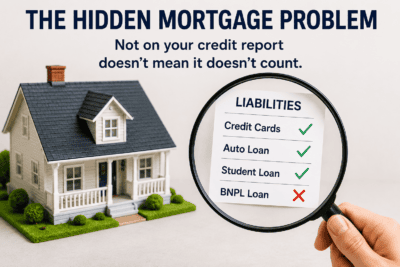 Here’s where BNPL becomes particularly important when you’re buying a home.
Many borrowers assume that if a debt isn’t on their credit report, it doesn’t exist as far as the mortgage lender is concerned.
That’s not how mortgage underwriting works.
Fannie Mae’s underwriting guidelines state that a lender’s analysis must include liabilities affecting a borrower’s ability to make the mortgage payment. They also specifically require verification of liabilities that aren’t shown on the credit report.
Even more importantly, Fannie Mae’s Desktop Underwriter calculates DTI using the liabilities entered on the mortgage application, not simply the debts appearing on the credit report.
In other words:
Not appearing on your credit report does not necessarily mean a debt disappears from your mortgage qualification.
Why Your Debt-to-Income Ratio Matters
 One of the most important numbers in mortgage qualification is your debt-to-income ratio, or DTI.
DTI compares your qualifying monthly financial obligations with your gross monthly income. The higher your monthly debt payments, the less room you have for a mortgage payment.
Fannie Mae includes installment debts and other recurring obligations in the calculation of total monthly obligations, subject to its underwriting rules.
And this is where several seemingly insignificant BNPL payments can suddenly become very significant.
Suppose you earn $8,000 per month before taxes and have:
- $700 in qualifying monthly debt payments
- A proposed $2,700 monthly housing payment
That’s $3,400 in monthly obligations, producing a DTI of 42.5%.
Now add several BNPL or other installment payments:
- Furniture: $175 per month
- Electronics: $125 per month
- Clothing: $100 per month
- Another financed purchase: $150 per month
That’s another $550 every month.
Your monthly obligations are now $3,950, and your DTI has jumped to approximately 49.4%.
Your income didn’t change.
The house didn’t change.
The proposed mortgage didn’t change.
Your debt did.
And those “small” monthly payments just changed your mortgage qualification considerably.
This example is for illustration only; whether a particular obligation must be included depends on the applicable mortgage program and underwriting requirements.
One $75 Payment May Not Be the Problem. Five Might Be.
 This is another danger with Buy Now, Pay Later: it’s remarkably easy to accumulate multiple loans without feeling as though you’re taking on significant debt.
You finance a $400 purchase here.
A piece of furniture there.
Then a phone, airline tickets, clothes or a new television.
Each payment looks manageable on its own:
$49.
$78.
$112.
$135.
But your mortgage lender isn’t evaluating whether each individual purchase seemed affordable when you made it. The lender is evaluating your overall financial obligations and your ability to repay the mortgage.
Suddenly, you may have hundreds of dollars every month committed to purchases you barely think about anymore.
For someone whose DTI is already near a mortgage qualification threshold, that can make a meaningful difference.
And Some of This Debt Can Be Expensive
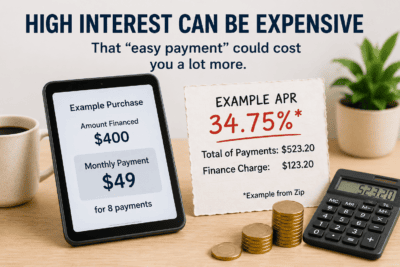 There’s another reason to think twice about BNPL while preparing to buy a home: you could be paying an extraordinarily high interest rate for the privilege of reducing your borrowing capacity.
Affirm’s current terms permit APRs as high as 36%, and Klarna’s term financing can reach 35.99%.
That’s a very different proposition from the cheerful “pay over time” message you see at checkout.
And it’s why you need to look beyond the payment amount.
A $90 monthly payment might sound perfectly manageable. But if you’re paying an APR north of 30% while simultaneously trying to put yourself in the strongest possible financial position to qualify for a mortgage, that purchase deserves another look.
“It’s Not On My Credit Report” Isn’t a Mortgage Strategy
 Your credit report is important during mortgage underwriting, but it isn’t the lender’s only source of information.
Fannie Mae specifically requires lenders to evaluate liabilities affecting a borrower’s ability to meet the mortgage obligation and provides procedures for verifying liabilities that don’t appear on the credit report.
That’s an important distinction:
Credit score and debt-to-income ratio aren’t the same thing.
A BNPL obligation might not have affected your credit score in the way you expected. That doesn’t automatically mean the payment is irrelevant when your lender evaluates your monthly debts.
So don’t make the mistake of reviewing your credit report, seeing no Klarna, Affirm or Zip account and concluding that your BNPL balances don’t matter.
Already Preapproved? This Matters Even More.
Mortgage preapproval isn’t the finish line.
Your lender qualified you based on a particular financial picture: your income, assets, credit and debts at that point in time.
Taking on additional debt afterward can change that picture.
Fannie Mae’s guidelines specifically address additional debts disclosed or discovered after underwriting and before or at closing. Depending on the effect on DTI, the loan may need to be re-underwritten.
That makes the period between preapproval and closing an especially bad time to start financing purchases for your future house.
The new sofa can wait.
So can the television.
And the refrigerator.
Don’t finance a house full of things for a house you haven’t closed on yet.

What If You Already Have Buy Now, Pay Later Loans?
Don’t panic—and don’t start randomly paying things off without talking with your mortgage professional.
Instead, make a list of every outstanding BNPL obligation you have, including:
- The company
- Current balance
- Required payment
- Number of payments remaining
- Interest rate, if applicable
Then give that information to your lender.
Mortgage guidelines distinguish among different types of debt and remaining repayment periods. Under current Fannie Mae guidelines, for example, installment debts with more than 10 monthly payments remaining generally must be included in recurring monthly debt obligations. Debts with 10 or fewer payments remaining may still need to be included if the payment significantly affects the borrower’s ability to meet credit obligations.
There are also circumstances in which paying down or paying off debt can affect mortgage qualification, which is another reason to discuss the strategy with your lender before moving money around.
Let your mortgage professional determine how the particular obligation should be treated under the loan program you’re using.
Before You Click “Pay Later,” Think About the House
 Buy Now, Pay Later can make an expensive purchase feel inexpensive because it shifts your attention from what something costs to what the payment costs today.
That’s exactly the wrong way to think when you’re preparing for a mortgage.
If buying a home is on your radar, every new financial obligation deserves scrutiny.
Before financing that $800 purchase, ask yourself:
Is whatever I’m buying today worth potentially reducing what I can qualify to buy in a home tomorrow?
Because when you’re applying for a mortgage, that little “Pay Later” button may have consequences long after you’ve forgotten what you bought.
Ready to Buy a Home in Greater Charlotte?
Buying a home starts long before you walk through the first front door. Understanding what you can comfortably afford—and making smart financial decisions before and during the mortgage process—can have a significant impact on your buying power.

I’ve been helping Greater Charlotte home buyers since 1999, and that experience includes helping buyers prepare for the mortgage process and understand the financial decisions that can affect how much home they qualify to purchase. I can also introduce you to top mortgage lenders in the Greater Charlotte area who can review your finances, explain your loan options and help you determine your buying power before you begin seriously shopping for a home.
If you’re thinking about buying a home in Charlotte or the surrounding area, contact Nina Hollander, Broker with Coldwell Banker Realty, at 704-779-0813. Let’s put the right real estate and mortgage team in place and get you prepared to buy with confidence.
Thinking about buying or selling a home in the Charlotte area?
Nina Hollander is an expert local real estate agent serving Charlotte and surrounding communities. Whether you’re just starting your search or ready to make a move, Nina is here to provide trusted guidance every step of the way. Contact Nina today to get personalized help with your real estate goals.
Thinking about selling your Charlotte home? Request our free Charlotte home value report and to see what your home may be worth in today’s real estate market.
Check out the Real Estate Market in Charlotte NC
I work hard for my clients to ensure they have the best selling or buying experience possible. For comprehensive real estate information in the Greater Charlotte NC area, check out the links below!